Tired of paper-based permits?
Smart Permit electronic system: ready-made templates for all types of work, electronic signature, automatic log, deadline reminders. Save up to 70% of permit processing time. A single document in Excel takes 40 minutes. In Smart Permit: 3 minutes.
A gas-hazardous work permit (Russian: naryad-dopusk na gazoopasnye raboty) is the written authorisation that Russian law requires before any job that may release flammable, toxic or inert gas at a hazardous production facility (HPF). Running Group I work without it exposes the organisation to a fine up to 1,000,000 RUB (~$10,900 at about 92 RUB/USD, June 2026) and suspension of the facility for up to 90 days, under Article 9.1(3) of the Code of Administrative Offences. This guide explains, for expatriate HSE managers and foreign contractors operating in Russia, which operations need the permit, who signs and approves it, how to complete the form, and how long it stays valid and on file.
1. What gas-hazardous work is and why the permit matters
Gas-hazardous work covers operations where flammable, toxic or inert gases may enter the work area at concentrations that can cause an explosion, fire, poisoning or asphyxiation. Typical examples are tie-ins to live gas pipelines, repair of equipment that held hazardous substances, opening and cleaning vessels, and the first gas start-up. The employer approves a list of such operations and splits them into Group I and Group II by hazard level. The group decides whether a written permit is required or a register entry is enough.
In Western terms this is a permit-to-work (PTW) system, close to the hot-work and confined-space permits familiar from OSHA and HSE UK practice. Russia codifies it more rigidly: the form, the responsible roles and the gas-rescue coordination are all prescribed by federal rules. The permit does three things: it fixes the preparation and safety measures, it assigns personal responsibility for preparation and for execution, and it sets the crew, the protective equipment and the air-monitoring routine. The wider system is covered in the permit-to-work reference.
2. Legal basis: FNP 528 and related acts
The primary act is the Federal Norms and Rules "Safe Conduct of Gas-Hazardous, Hot and Repair Work", approved by Rostekhnadzor Order No. 528 of 15.12.2020 (FNP No. 528). It took effect on 01.01.2021. Its validity was extended to 01.09.2032 by Rostekhnadzor Order No. 62 of 03.03.2026, and the current revision dates from 03.03.2026 (in force from 09.05.2026).
| Act | Scope | Application |
|---|---|---|
| Rostekhnadzor Order No. 528 of 15.12.2020 (FNP) | Safe conduct of gas-hazardous, hot and repair work | HPFs where such work is performed |
| Rostekhnadzor Order No. 531 of 15.12.2020 (FNP) | Safety of gas distribution and consumption networks | Pipelines, gas control points, gas equipment |
| Rostekhnadzor Order No. 440 of 13.11.2020 (FNP) | Industrial safety in mining and metallurgy | Gas-hazardous areas of metallurgy |
| Ministry of Labour Order No. 776n of 29.10.2021 | Model OHS management regulation; Annex No. 2 lists high-risk work | Gas-hazardous work appears as an example |
| Gov. Decree No. 2464 of 24.12.2021 | OHS training and knowledge testing | Programme "V" for high-risk work |
A common error among foreign teams is to assume one general standard applies. It does not. FNP No. 528 excludes gas distribution networks (Order No. 531) and mining-metallurgy facilities (Order No. 440), and it expressly excludes trunk pipeline transport from its scope (clause 4). For those objects, sector-specific rules govern. More on regulatory requirements: Rules for work under a permit.
3. Group I and Group II by hazard level
Under clause 12 of FNP No. 528, gas-hazardous work is split into two groups:
| Parameter | Group I | Group II |
|---|---|---|
| Written permit | Mandatory | Not required |
| Logging | Permit + permit register | Register of work done without a permit |
| Nature | High risk of explosion and poisoning | Recurring operations, part of the process |
| Crew | Defined by the permit | At least two people |
Drawing up and approving the list
Each facility draws up a list of gas-hazardous work split into the two groups. The head of the structural unit prepares it (clauses 13-15), the head of the operating organisation (or an authorised deputy or branch head) approves it and reviews it at least once a year and whenever the process or layout changes (clause 16). The list is coordinated with the gas-rescue unit (PASS(F)) and the production-control service. Any operation not on the list is done under a permit and added to the list within ten days (clause 17). For the full picture of activities that require a permit, see high-hazard work.
4. Responsible persons and coordination
Unlike the electrical permit, FNP No. 528 has no "issuer" or "permit acceptor" roles. Two responsible persons matter, both engineering-technical staff of the operating organisation, appointed from an approved list (clause 21):
| Role | Appointed from | Duties |
|---|---|---|
| Person responsible for preparation | ETS of the operating organisation | Ensures isolation, blanking, purging and cleaning of the workplace |
| Person responsible for execution | ETS of the operating organisation | Directs the crew, controls safety measures, stops the work when needed |
| Safety attendant | Crew member outside the vessel | Continuously watches the worker inside and keeps contact |
Managers and staff responsible for preparation and execution hold industrial-safety attestation matching their duties (clause 5). Where one crew handles both preparation and execution, a single supervisor may be appointed for both stages, provided that person knows the safe methods and is freed from other duties during the work (clause 21).
The permit is coordinated with a professional emergency rescue service or unit (PASS(F)) certified for gas-rescue work, in-house or under contract. For a contractor, the contractor's head approves the list of its responsible persons and sends it to the client; execution is run by the contractor's engineering staff under the operator's control. Who is responsible for what: who issues a permit.
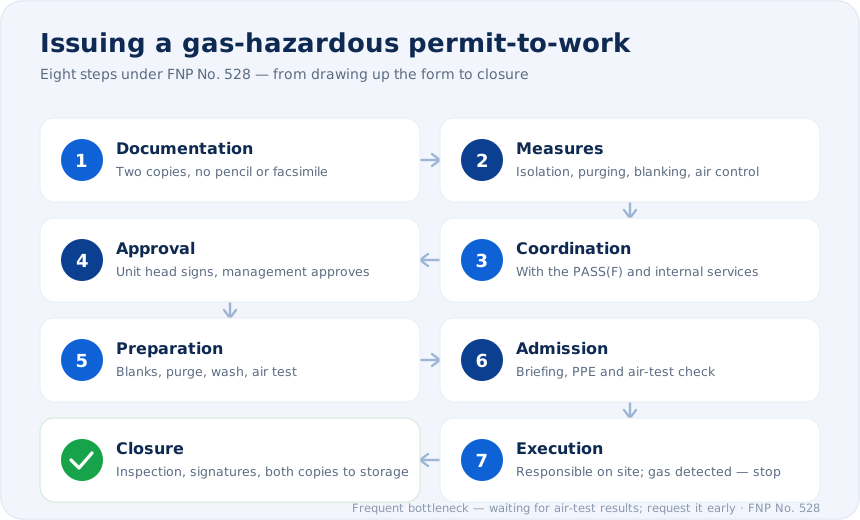
5. Issuing the permit step by step
- Documentation. The permit is drawn up in two copies (clause 20). It may be completed on a computer. Pencil, facsimile signatures and photocopies are prohibited (clause 24).
- Measures. Define the scope, the hazards, the preparation measures (isolation, purging, blanking), the protective equipment and the air-monitoring order.
- Coordination. Coordinate the permit with the PASS(F) and any other services set by internal rules.
- Approval. The head of the structural unit signs it; the head of the operating organisation, a deputy or a branch head approves it (clause 23). A site layout signed by the unit head is attached.
- Preparation. Isolate equipment and fit blanks per the scheme, purge, wash and steam vessels, then test the air.
- Admission. The person responsible for execution briefs the whole crew on site, checks PPE, the air-test results and the readiness of firefighting and communication means. Each member signs.
- Execution. The responsible person stays on site throughout, controlling compliance. If conditions change or gas is detected, work stops and the crew leaves the area.
- Closure. After the job, both responsible persons inspect the workplace and sign the closure. Both copies go to storage.
The most frequent bottleneck is waiting for air-test results, so experienced engineers request the analysis while the form is still being drawn up. A step-by-step guide with samples: issuing a permit-to-work.
6. What the form contains
The recommended permit form is Annex No. 2 to FNP No. 528. It records the type and nature of the work; the location with equipment references; the crew; the hazardous substances with their exposure limits; the preparation measures; the protective equipment; the air-test results; the isolation scheme; and the signatures of the responsible persons, the PASS(F) and the approving manager. Entries must be legible, and corrections are not allowed: on error, the form is reissued. This matters, because an illegible or amended permit becomes a serious problem for responsible persons during an accident investigation.
7. Validity and extension
The permit is issued per location and per type of work for each crew, and it is valid for one work shift (clause 20). This is the key difference from the electrical permit, where the term reaches 15 days.
| Object | Validity | Extension |
|---|---|---|
| HPF (FNP No. 528, clause 20) | One work shift | No more than one day shift |
| Gas distribution networks (FNP No. 531) | Per Annex No. 1 to FNP No. 531 | Per sector rules |
The head of the structural unit may extend it only if the scope is unchanged and safe conditions are confirmed by air monitoring. A new permit is issued if conditions change. Where gas-hazardous and hot work coincide, a separate permit is issued for each. Full terms by work type: permit validity periods.
8. Group II: work without a permit
Not all gas-hazardous work needs a permit. Group II work is done without one but is logged before it starts in the register of gas-hazardous work performed without a permit (Annex No. 3). Group II covers recurring operations that are part of the process, with a fixed location, an unchanged nature and a defined crew (clause 19), such as sampling and draining apparatus.
Emergency response is separate: localisation and clean-up of an accident proceed without a permit until the direct threat to life, health, property and the environment is removed, under the accident-response plan (PMLA). Once conditions stabilise, further work resumes under a permit. The full set of exceptions: work without a permit.
9. Air monitoring and safety measures
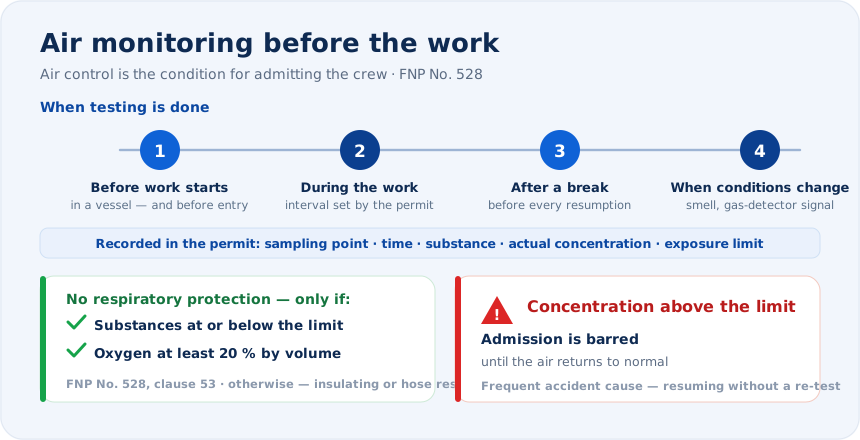
Air monitoring is the condition for admitting the crew, and the results go in the permit. Testing is done before the work starts (clause 31), before entry into a vessel (clause 44), during the work (clause 36) at the interval set by the permit, and before resuming after a break. If the limit is exceeded, admission is barred until the air returns to normal.
Protective equipment depends on the substances. Inside vessels, workers use hose or oxygen-insulating respirators or air-supplied breathing apparatus; filtering respirators are not allowed inside vessels (clause 48). Work without respiratory protection is possible only when hazardous substances stay at or below the exposure limit and oxygen is at least 20% by volume (clause 53). Tools must be made of a spark-free material (clause 42), firefighting means must be on site, smoking and open flame are banned, and no person not involved in the work may be in the area (clause 36).
10. Work inside vessels: confined-space rules
Work inside vessels, apparatus and tanks is the most dangerous category, and it maps onto what OSHA calls a permit-required confined space (29 CFR 1910.146). The Russian rules are strict in their own way:
- The vessel is freed of hazardous substances and isolated with blanks per a scheme attached to the permit.
- It is washed, steamed and purged, and the air is tested before entry (clause 44).
- The crew is at least two people, one working and one attending outside (clause 49).
- The worker wears a safety belt or full-body harness with a signal-rescue line led outside (clause 49).
- The attendant keeps continuous visual or voice contact.
Admission is granted only after full preparation: isolation, blanking, steaming or purging, and a confirmed safe concentration.
11. Retention period
The retention period is often confused with validity. The permit is valid for one shift but is kept much longer.
| Item | Period | Basis |
|---|---|---|
| Permit (paper, both copies) | At least 6 months from closure | FNP No. 528, clause 64 |
| Electronic permit | 1 year from closure | FNP No. 528, clause 24 |
| Permits for first gas start-up, tie-in, cut-out by welding (distribution networks) | Permanently, with the as-built file | FNP No. 531, clause 143 |
The six-month term in clause 64 is general for any gas-hazardous work, not specific to vessels. The "three months" figure from older in-house instructions does not match the current Rules. Full storage table: permit retention period.
12. Penalties and liability
Offences fall under Article 9.1 of the Code of Administrative Offences. The part of the article matters. Amounts are in RUB with an approximate USD figure (at about 92 RUB/USD, June 2026; check the current Central Bank of Russia rate).
| Offence | Officer | Legal entity |
|---|---|---|
| 9.1(1) breach of industrial-safety requirements | 20,000-30,000 RUB or disqualification 6 months-1 year | 200,000-300,000 RUB (~$2,170-3,260) or suspension up to 90 days |
| 9.1(3) gross breach | 40,000-50,000 RUB or disqualification 1-2 years | 500,000-1,000,000 RUB (~$5,400-10,900) or suspension up to 90 days |
A gross breach is one that creates a direct threat to people's life or health (note to Article 9.1). Criminal liability applies under Article 217 of the Criminal Code (industrial-safety violations at an HPF: up to 3, 5 or 7 years depending on the harm), Article 216 (safety in construction or other work) and Article 143 (occupational-safety requirements). Appointing responsible persons does not relieve the employer. Who is responsible for what: responsible persons; the related hot-work rules: hot work permit.
Sources
- Rostekhnadzor Order No. 528 of 15.12.2020, FNP "Safe Conduct of Gas-Hazardous, Hot and Repair Work" (rev. 03.03.2026, in force until 01.09.2032) - full text on Consultant.ru (in Russian)
- Code of Administrative Offences, Article 9.1 - Consultant.ru (in Russian)
- OSHA 29 CFR 1910.146, Permit-Required Confined Spaces (comparison) - osha.gov
Still issuing gas-hazardous permits on paper? The naryad-dopusk.com platform fills the Annex No. 2 form, tracks the one-shift validity and keeps an electronic register, fully compliant with FNP No. 528. Try it free
Frequently Asked Questions
How long is a gas-hazardous work permit valid in Russia?
It is issued per location and per type of work for each crew and is valid for one work shift (clause 20 of FNP No. 528). If the job is unfinished and conditions have not changed (confirmed by air monitoring), the head of the structural unit may extend it by no more than one day shift. There is no 15-day option, unlike the electrical permit.
Who signs and who approves the permit?
The permit is signed by the head of the structural unit and approved by the head of the operating organisation, an authorised deputy or a branch head (clause 23 of FNP No. 528). Before approval it is coordinated with the professional emergency rescue unit (PASS(F)).
Is coordination with gas-rescue services required?
Yes. The permit is coordinated with a professional emergency rescue service or unit (PASS(F)) certified for gas-rescue work, either in-house or under contract. Without this coordination the permit is invalid. This has no exact OSHA equivalent; the closest analogue is a standby rescue arrangement.
Which gas-hazardous work is done without a permit?
Group II work: recurring operations that are part of the process, with a fixed location, unchanged nature and a defined crew (clause 19). It is logged before it starts in the register of gas-hazardous work performed without a permit. Group I always requires a written permit.
How long must the permit be kept?
Both copies are kept for at least six months from the date of closure (clause 64 of FNP No. 528). An electronic permit is kept for one year (clause 24). The "three months" figure from older in-house instructions is outdated.

Tired of paper-based permits?
Smart Permit electronic system: ready-made templates for all types of work, electronic signature, automatic log, deadline reminders. Save up to 70% of permit processing time. A single document in Excel takes 40 minutes. In Smart Permit: 3 minutes.