Tired of paper-based permits?
Smart Permit electronic system: ready-made templates for all types of work, electronic signature, automatic log, deadline reminders. Save up to 70% of permit processing time. A single document in Excel takes 40 minutes. In Smart Permit: 3 minutes.
Working in electrical installations without a properly issued permit-to-work (Russian: naryad-dopusk) is not only a risk of serious electric shock - it is direct legal exposure: a fine of 50,000 to 130,000 RUB for the organisation depending on the offence (Article 5.27.1 of the Code of Administrative Offences), and, if someone is injured, criminal liability under Article 143 of the Criminal Code. This guide explains, for expatriate HSE managers and foreign contractors operating in Russia, when the permit is mandatory, who issues it, which electrical safety groups are required, how to complete the form under Ministry of Labour Order No. 903n, and what the terms and penalties are.
1. What the electrical permit-to-work is and why it matters
A permit-to-work in electrical installations is a written task that fixes the scope, location, start and end time, safe-working conditions, and the people responsible for the job. This is the definition in clause 4.1 of the Labour Protection Rules for the Operation of Electrical Installations, approved by Ministry of Labour Order No. 903n of 15.12.2020. The recommended permit form is Annex No. 7 to the Rules; the form is fixed and may not be altered.
In Western practice this maps onto the permit-to-work (PTW) system familiar from OSHA and IEC/ISO guidance, but Russia codifies it more rigidly: the form, the roles and the electrical safety groups are all prescribed by law. The permit does three things: it records the scope and location (using dispatcher equipment names and the voltage), it defines the preparation measures (isolation, proving dead, earthing, safety signs, barriers), and it assigns personal responsibility to each officer - the issuer, the work controller, the permit acceptor, the work supervisor and the team members.
It is drawn up in two copies; if transmitted by phone, radio, fax or electronically, in three (clause 6.1).
2. Legal basis: Order 903n, PTEEP and related acts
| Act | Number and date | Scope | Status |
|---|---|---|---|
| Labour-protection rules for electrical installations | Min. of Labour Order No. 903n of 15.12.2020 (rev. 29.04.2025) | Occupational safety: permits, safety groups, responsible persons, technical measures | In force until 01.09.2031 |
| PTEEP | Min. of Energy Order No. 811 of 12.08.2022 | Technical operation of consumer electrical installations: owner duties, staff categories | In force since 07.01.2023 |
| OHS management model regulation | Min. of Labour Order No. 776n of 29.10.2021 | Annex No. 2: sample list of high-risk work | In force |
| Training procedure | Gov. Decree No. 2464 of 24.12.2021 | OHS training, knowledge testing, briefings | In force |
The two key acts complement each other: Order 903n sets the occupational-safety requirements (how to organise the work, which groups are needed, which measures to take), while PTEEP / Order 811 governs technical operation (how to maintain installations, which staff categories are mandatory). When issuing a permit, the primary act is 903n. A common error among foreign teams is to assume PTEEP (the technical-operation rules) is the safety basis - it is not. Detailed breakdown: Order 903n for practitioners.
3. Three forms of organising work
Under clause 4.1 of Order 903n, work in live electrical installations is organised in one of three forms: by permit-to-work, by verbal authorisation (Russian: rasporyazhenie), or under a list of routine-operation tasks. The permit-to-work is the strictest form, reserved for higher-risk operations.
| Form | Risk level | Validity | Example |
|---|---|---|---|
| Permit-to-work | High | Up to 15 days (1 day if live) | Major repair of a 10 kV transformer |
| Verbal authorisation | Medium | Working day / shift | Replacing fuses in a switchgear up to 1000 V |
| Routine operation | Low | Per approved list | Cleaning, wiping equipment enclosures |
A permit is mandatory for work with rated voltage removed, work on or near live parts, work with induced voltage above 25 V, high-voltage testing, major repair of equipment above 1000 V, and repair of overhead lines (clauses 4.1, 4.4). A frequent State Labour Inspectorate (GIT) finding is that the employer has not approved the list of work done by permit - which is itself a separate violation. When and how to choose the form: Work without a permit.
4. Responsible persons and electrical safety groups
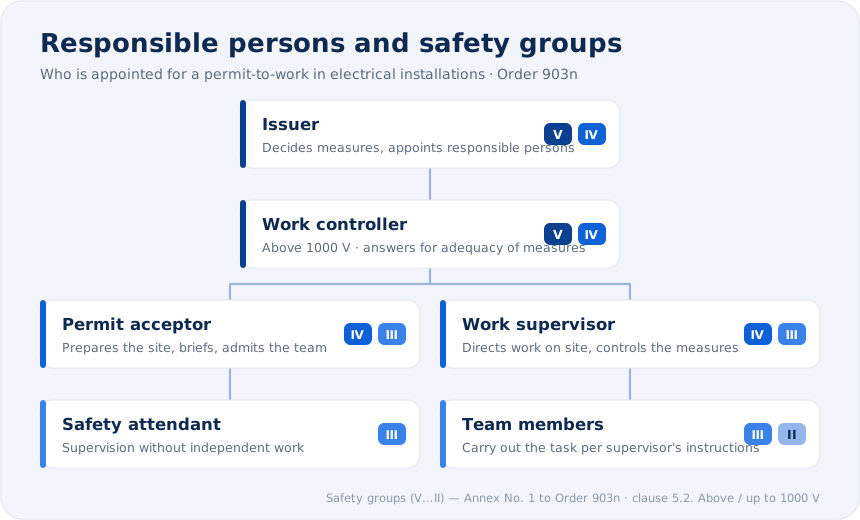
The work requires several categories of responsible person (clause 5.2).
| Role | Appointed from | Safety group | Key duties |
|---|---|---|---|
| Issuer | Administrative-technical staff | V (>1000 V), IV (≤1000 V) | Decides necessity and feasibility; appoints responsible persons and measures |
| Work controller | Administrative-technical staff | V (>1000 V), IV (≤1000 V) | Appointed above 1000 V; answers for adequacy of measures |
| Permit acceptor | Operational / operational-repair staff | IV (>1000 V), III (≤1000 V) | Verifies site preparation, gives the targeted briefing, admits the team |
| Work supervisor | Repair / operational-repair staff | IV (>1000 V), III (≤1000 V) | Directs work on site, controls safety compliance |
| Safety attendant | Electrical staff | III | Supervises where the team cannot work independently |
| Team members | Electrical / electrotechnological staff | III (>1000 V), II (≤1000 V) | Carry out the task per the supervisor's instructions |
Electrical safety groups I-V
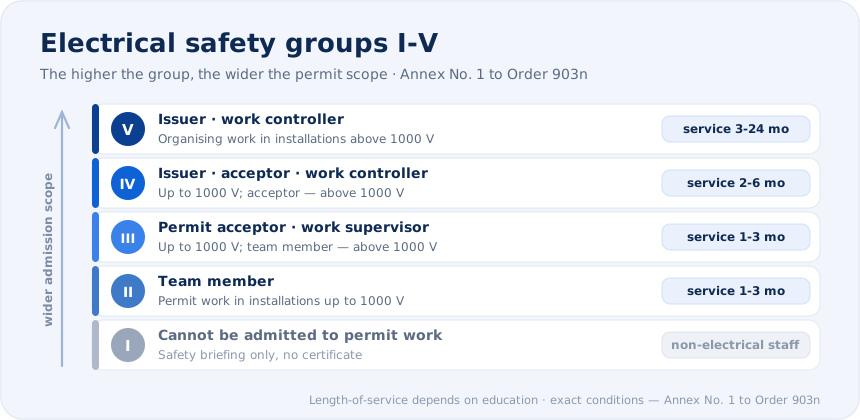
Personnel are classified into five electrical safety groups (a Russia-specific qualification ladder; the nearest Western analogue is the UK "authorised/competent person" tiers, but it is not an exact equivalent). The conditions for assigning each group are set in Annex No. 1 to Order 903n; the exact length-of-service requirements depend on the worker's level of education and are given in that annex. Group I cannot be admitted to permit work; group II and above can take defined roles, up to groups IV and V which alone may issue permits. Detail: Electrical safety groups II-V. Who may issue and on what basis: Who issues the permit.
5. Completing the permit: step by step
The form (Annex No. 7) has a front and a back. The sequence:
- The issuer completes the front: scope, location, responsible persons, team, and the preparation measures.
- The issuer gives the targeted briefing to the work controller and supervisor; both sign.
- Two copies pass to the permit acceptor and the supervisor; issue is logged (Annex No. 8).
- The permit acceptor, with the supervisor, verifies site preparation: isolation done, earths applied, signs posted, barriers up.
- The acceptor briefs the supervisor and team; each signs.
- The supervisor briefs the team at the workplace, with signatures on the back.
- The acceptor authorises the start; date and time are recorded.
- Each shift, the supervisor inspects the site and records the daily admission.
- On completion the permit is closed with the signatures of the supervisor and acceptor; both copies go to storage.
Common errors found by GIT and Rostekhnadzor: generic wording ("repair the equipment") instead of exact dispatcher names; measures not tied to specific switching devices; a formal briefing without all signatures; a live-work permit issued for more than one day. Full algorithm and sample forms: Completing a permit-to-work: 2026 step-by-step.
6. Admission, supervision and breaks
At first admission the permit acceptor, with the work controller and supervisor, verifies that the site is correctly prepared and tells the team which parts remain live, what measures are in place, and where earths, signs and barriers are. The supervisor then maintains continuous supervision; leaving the team unattended is prohibited, except where group-III workers operate at separate, predefined positions after a specific briefing (clause 6.13). At the end of a shift the site is cleared and the permit returned to the acceptor; the next day a fresh admission follows a site inspection.
7. Overhead lines: specifics
For overhead power lines (OHL) the permit is issued per work group separately, and the acceptor checks earthing on all de-energised parts near the workplace. Work near an OHL protection zone is issued with the permissible clearances in mind (Table No. 1 of the Rules). During a thunderstorm, all OHL work stops. Where lines of different owners cross, each organisation issues its own permit and admission is coordinated between both operational services - a requirement whose breach is a frequent cause of incidents.
8. Validity and storage
Terms are set strictly by clause 6.3 of Order 903n.
| Parameter | Value | Basis |
|---|---|---|
| Maximum term (de-energised) | 15 calendar days from start | clause 6.3 |
| Extension | Once, by up to 15 calendar days | clause 6.3 |
| Maximum total | Up to 30 calendar days (15 + 15) | clause 6.3 |
| Live work | 1 calendar day (one shift) | clause 6.3 |
| Extension of live work | Not allowed; a new permit is issued | clause 6.3 |
| Storage after closure | 1 year | Art. 415, Federal Archive Order No. 236 |
| Storage if an accident occurred | 45 years with the investigation file | Federal Archive Order No. 236 |
A live-work permit may not be extended into a second day - a violation of clause 6.3 routinely flagged by Rostekhnadzor. Full table of terms by work type: Permit-to-work validity periods.
9. Penalties and liability
Operating without a proper permit, with defects in it, or with untrained workers carries serious consequences. It matters which part of Article 5.27.1 of the Code of Administrative Offences applies: a general OHS breach and admitting an untrained worker are different offences. Amounts below are in RUB with an approximate USD figure (at about 92 RUB/USD, June 2026; check the current Central Bank of Russia rate).
| Offence | Officer / sole trader | Legal entity |
|---|---|---|
| Art. 5.27.1(1) - breach of OHS requirements | 2,000 - 5,000 RUB | 50,000 - 80,000 RUB (~$540-870) |
| Art. 5.27.1(3) - admitting a worker without training/medical check | 15,000 - 25,000 RUB | 110,000 - 130,000 RUB (~$1,200-1,400) |
| Art. 5.27.1(5) - repeat offence | 30,000 - 40,000 RUB or disqualification 1-3 years | 100,000 - 200,000 RUB or suspension up to 90 days |
| Art. 9.11 - breach of electrical-installation operating rules | 2,000 - 4,000 RUB | 20,000 - 40,000 RUB |
Criminal liability under Article 143 of the Criminal Code: serious harm to health - a fine up to 400,000 RUB or up to 1 year of imprisonment; death of one person - up to 4 years; death of two or more - up to 5 years. Electrical work is on the high-risk list (Order No. 776n, Annex No. 2). Liability covers the issuer, work controller, permit acceptor, supervisor and the head of the organisation; appointing responsible persons does not relieve the employer. Who is responsible for what: Responsible persons.
Still issuing electrical permits-to-work on paper? The naryad-dopusk.com platform fills the Annex No. 7 form, tracks the 15-day (or 1-day live-work) deadlines automatically and keeps an electronic log - fully compliant with Order 903n. Try it free
Frequently Asked Questions
How long is an electrical permit-to-work valid in Russia?
For de-energised work, up to 15 calendar days from the start date, extendable once by a further 15 days (30 days total). For live work on conductive parts, one calendar day (one shift) with no extension - a new permit is issued (clause 6.3 of Order No. 903n).
Which electrical safety group is required to issue a permit?
In installations above 1000 V, group V; up to 1000 V, group IV (Section V of Order No. 903n). The issuer is appointed from administrative-technical staff by an order of the head of the organisation.
How does an electrical permit differ from a work-at-height permit?
Different qualification system (electrical safety groups I-V vs height groups 1-3), a dedicated "permit acceptor" from operational staff, a different legal basis (Order 903n vs Order 782n) and different permit forms.
Can the permit be issued electronically?
Yes. Order 903n allows an electronic format (clause 4.1). The signing procedure is set by the employer's local regulations. An electronic form speeds up completion and lets you track deadlines automatically.
How long must a closed permit be kept?
One year after closure (Article 415 of Federal Archive Order No. 236 of 20.12.2019). If an accident occurred, the permit is kept with the investigation file for 45 years.
How does Order 903n differ from PTEEP (Order No. 811)?
Ministry of Labour Order No. 903n sets occupational-safety requirements (how to organise work safely, permits, electrical safety groups). PTEEP (Ministry of Energy Order No. 811 of 12.08.2022) governs the technical operation of consumer electrical installations. For issuing a permit, the primary act is 903n.
Sources

Tired of paper-based permits?
Smart Permit electronic system: ready-made templates for all types of work, electronic signature, automatic log, deadline reminders. Save up to 70% of permit processing time. A single document in Excel takes 40 minutes. In Smart Permit: 3 minutes.